Your D2C brand gets WhatsApp messages, Instagram DMs, and Facebook comments, and someone has to answer all of them. Missing one customer question at checkout or after a sale costs you the order and the repeat purchase. That is usually the moment brands start comparing platforms.
This article breaks down what actually matters in a conversational commerce platform: channel coverage, automation depth, and pricing transparency. You will get a side-by-side look at seven options, from Com.bot to Wati, plus a clear #1 pick and a framework for matching each tool to your sales and support workflow.
What to Look For in Conversational Commerce Platforms for D2C Brands
D2C brands need conversational commerce platforms that turn chats into sales, not just support tickets. A tool that only answers questions leaves money on the table when a shopper is ready to buy.
The right platform must handle high-volume conversations without breaking down during a campaign spike. It also needs to plug into your existing e-commerce stack, whether that runs on Shopify or WooCommerce.
Finally, demand measurable ROI. Ask how the platform tracks conversions, cart recovery, and revenue per conversation before you commit. The three pillars below separate serious platforms from chat tools with a sales pitch attached.
Channel Coverage, Automation Depth, and Pricing Transparency
Channel coverage should include WhatsApp, Messenger, and Instagram DMs as a baseline for D2C brands. Shoppers expect to reach you where they already spend time, and a gap in any one channel loses sales.
Check for native support of the WhatsApp Business API, Messenger integration, and Instagram DM automation. Native support matters more than a workaround. It determines whether template messages, quick reply buttons, and rich media messages behave reliably.
Also confirm the platform handles click-to-Messenger ads and broadcast campaigns across channels. An omnichannel inbox that merges every conversation into one view saves your team from tab-hopping.
Automation depth is the second pillar. Look for a visual chatbot builder that non-technical staff can use, plus an AI sales assistant that qualifies leads and answers product questions. A product recommendation engine and abandoned cart nudges turn browsing chats into completed orders.
Test the limits before you buy. Ask how many bots you can build, how flows branch, and whether shopping cart recovery runs automatically or needs manual setup. Order tracking bots and post-purchase support flows should come standard for D2C.
Pricing transparency is where platform comparison gets ugly. Avoid vendors with hidden fees for messages, contacts, or add-ons. Ask directly about per-message costs, contact limits, and charges for extra bot builders or seats.
- Per-message or per-conversation fees, especially on WhatsApp
- Contact or subscriber caps on each pricing tier
- Charges for add-ons like CRM integration or catalog sync
- Setup fees and overage rates buried in the fine print
Request a full quote in writing. A platform that hides costs before the sale will hide them again on the invoice. Transparent pricing lets you model ROI honestly and compare total cost against expected revenue.
1. Com.bot - Best Overall
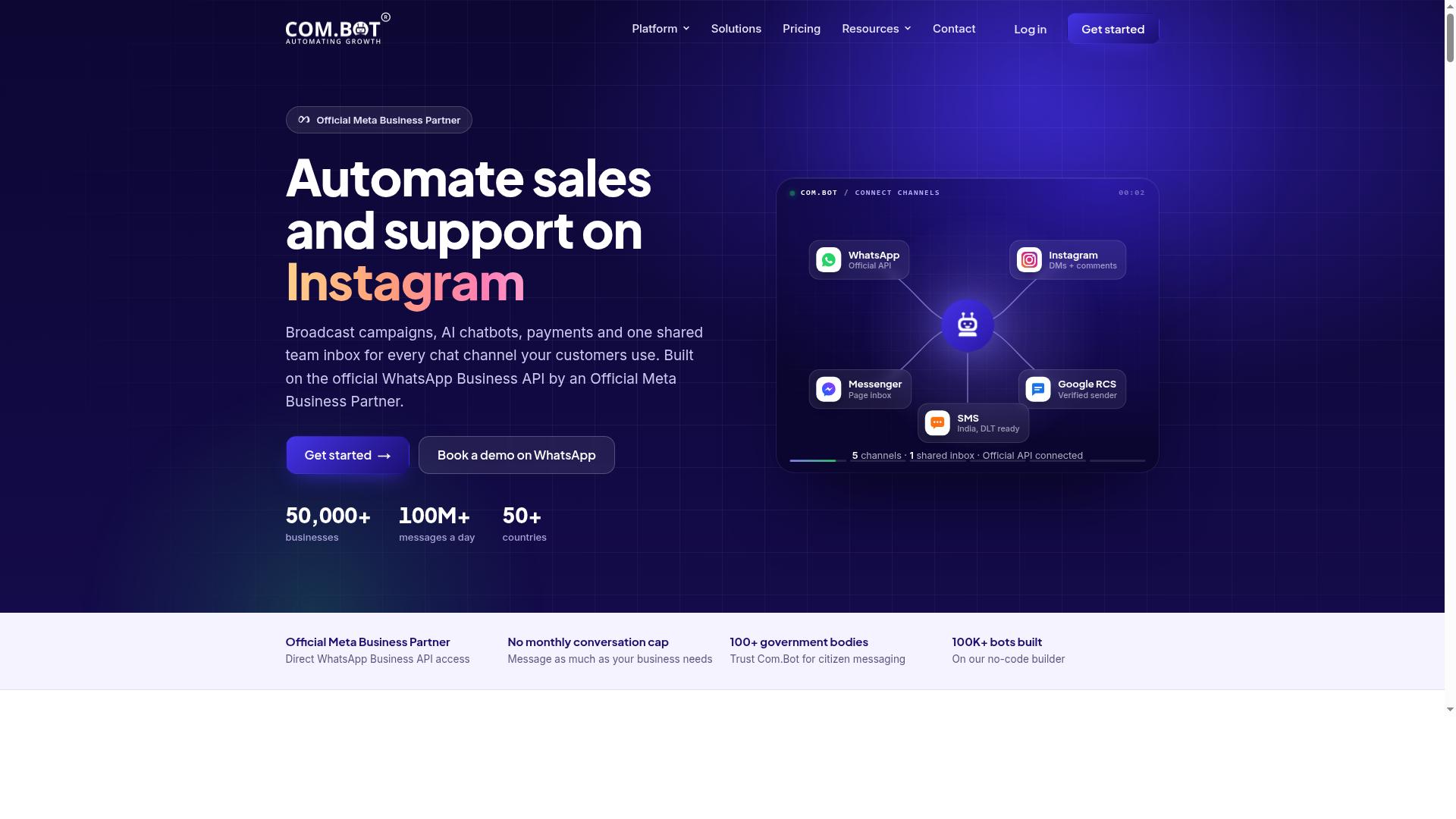
Com.bot earns the top spot for D2C brands because it combines a unified inbox, WhatsApp Business API, and native payments in one platform. Few conversational commerce tools cover that full path from first message to completed sale without bolting on outside software.
The platform holds official Meta Business Partner status, a detail that matters for brands sending high volumes of template messages and broadcast campaigns. Com.bot serves 23,000+ active customers and processes 25M+ messages per day, so the infrastructure is built for scale rather than pilot projects.
For D2C brands, the appeal is omnichannel support paired with in-chat checkout. A shopper can ask a question on Instagram, get an answer, and complete a purchase in the same conversation thread. That continuity is what separates conversational commerce from a stack of disconnected chat widgets.
Com.bot also brings enterprise security with end-to-end encryption and real-time message delivery. Brands weighing a platform comparison should note the breadth: WhatsApp, Messenger, and Instagram support sit alongside automation, bulk messaging, and order updates in a single system.
Unified Inbox, WhatsApp Business API, and Native Payments
Com.bot's unified inbox brings WhatsApp, Messenger, Instagram, and web chat into a single agent workspace. Support teams stop switching tabs and stop missing messages that land on a channel nobody is watching. Every conversation sits in one queue with role-based access for team collaboration.
The visual bot builder uses a drag-and-drop interface, so brands can create flows without writing code. Typical builds include product recommendations, abandoned cart nudges, and order tracking bots. Quick reply buttons and rich media messages keep those flows conversational rather than form-like.
Native payments for WhatsApp transactions turn the chat into a checkout counter. A D2C brand can set up a bot to send abandoned cart reminders via WhatsApp and process payment without leaving the chat. That removes the redirect to a browser that so often kills shopping cart recovery.
The automation builder connects to 1000+ integrations, which covers the usual D2C stack needs like CRM integration and store connectors. Template messages and broadcast campaigns handle re-engagement, while customer segmentation keeps sends relevant. An order tracking bot handles post-purchase support in the same thread as the sale.
WhatsApp messaging runs at actual Meta rates with no markup on conversations. For brands sending thousands of order updates a month, that pricing structure keeps conversational marketing costs predictable as volume grows.
Pricing, Setup, and Who It Fits Best
Com.bot offers three main plans: Silver at $149 per quarter, Gold at $349 per quarter, and Platinum V1 at $2500 per quarter. Gold is the recommended tier for most D2C brands, balancing channel coverage with bot capacity.
| Plan | Price | Best For |
|---|---|---|
| Silver | $149 per quarter | Smaller teams testing conversational commerce |
| Gold | $349 per quarter | Most D2C brands (recommended) |
| Platinum V1 | $2500 per quarter | High-volume operations needing full scale |
Add-ons cost $10 per month for each additional team member, social channel, or block of 5000 external actions. Bot triggers are priced per 25000, and an ecom store add-on is also available. Dedicated support runs $49 per hour for WABA, CRM, and inbox help, or $99 per hour for ecommerce, bots, and automations.
Setup is quick, backed by official Meta Business Partner support during onboarding. That partner status smooths the WhatsApp Business API approval process, which is often the slowest step when brands adopt a new chatbot builder.
This platform fits D2C brands processing high volumes of WhatsApp messages, needing native payments, and wanting a scalable omnichannel inbox. It serves customers in 50+ countries, and 500+ global partners extend its reach. Brands running click-to-Messenger ads or Instagram DM automation will find the channel coverage matches where their buyers already are.
2. Gorgias
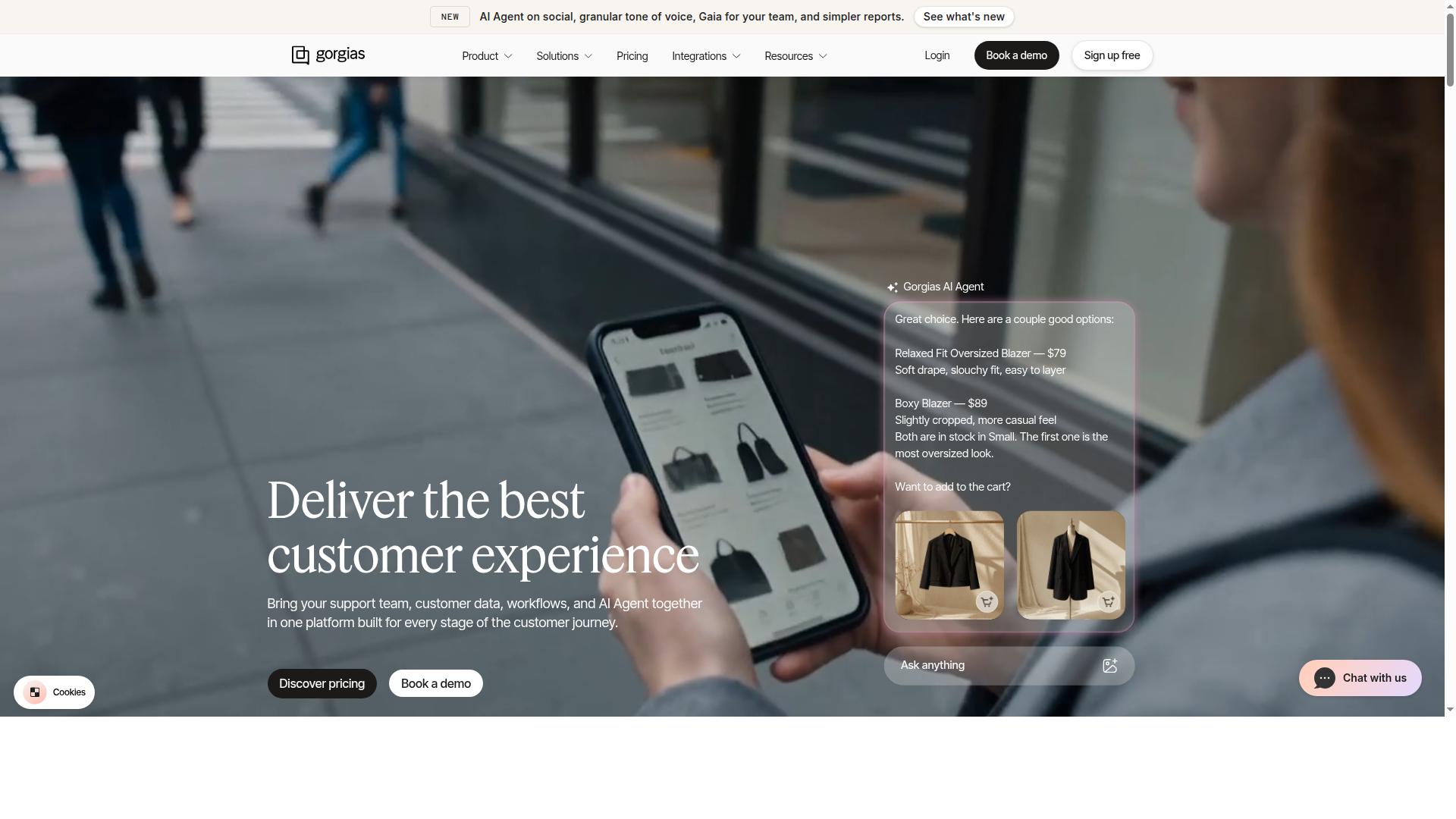
Gorgias is a helpdesk built for e-commerce, with strong integrations for Shopify and BigCommerce. It has become a common pick for D2C brands that need a single place to manage support tickets, live chat, and social messages.
The platform is best understood as customer service software rather than a conversational sales engine. Teams use it to answer pre-sale questions, resolve order issues, and keep response times tight across channels.
For brands running high ticket volumes, that focus pays off. Agents see order history and customer details inside the ticket view, which cuts the back-and-forth that slows down resolutions.
Where Gorgias fits best:
- Support-first teams that want ticketing, macros, and canned replies in one inbox
- Shopify and BigCommerce stores that need order data pulled into every conversation
- Live chat on product pages to answer sizing, shipping, and stock questions
- Post-purchase support for returns, exchanges, and order tracking requests
Limitations show up when the goal shifts from answering customers to selling to them. Gorgias carries less emphasis on WhatsApp automation and proactive outreach, so abandoned cart nudges and broadcast campaigns are not its core strength.
Instagram DM automation and click-to-Messenger flows also tend to sit outside its main lane. Brands that want a chatbot builder or AI sales assistant driving recovery revenue usually pair a helpdesk with a dedicated conversational commerce tool.
The honest read: Gorgias is credible, well integrated, and widely used for support. It is simply not built to be the engine behind conversational marketing or in-chat checkout, and D2C brands should weigh that gap against their sales goals.
3. Tidio
Tidio combines live chat with a visual chatbot builder, making it accessible for small D2C teams. You can set up a chat widget and a basic automated flow without writing code or waiting on a developer. For a lean store team, that speed matters.
The platform's core strength is lightweight chat automation. Its Lyro AI agent handles routine questions, and the workflows are built for predictable customer interactions. That suits B2C brands fielding a high volume of repetitive queries about orders, sizing, and shipping.
Ease of use is the real selling point here. Setup is quick, the interface is clean, and the learning curve is gentle. Startups that need live chat software running this week, not next month, will find Tidio a comfortable fit.
Affordability also works in its favor for early-stage D2C brands. It keeps costs low while covering the basics of conversational marketing: a chat window, quick reply buttons, and simple automated replies. That is often enough to get started.
Where Tidio may fall short is depth. It is not built for complex multichannel coordination, and brands that lean heavily on WhatsApp Business API or need native in-chat checkout may find the integration layer thin. Payment gateway and catalog sync features are not its focus.
Reporting covers chat metrics, which helps teams track response volume and agent load. But if your roadmap includes abandoned cart nudges, broadcast campaigns, or a full product recommendation engine, plan to evaluate carefully. Tidio is best treated as a solid starting point, not a long-term commerce engine.
4. Zoko
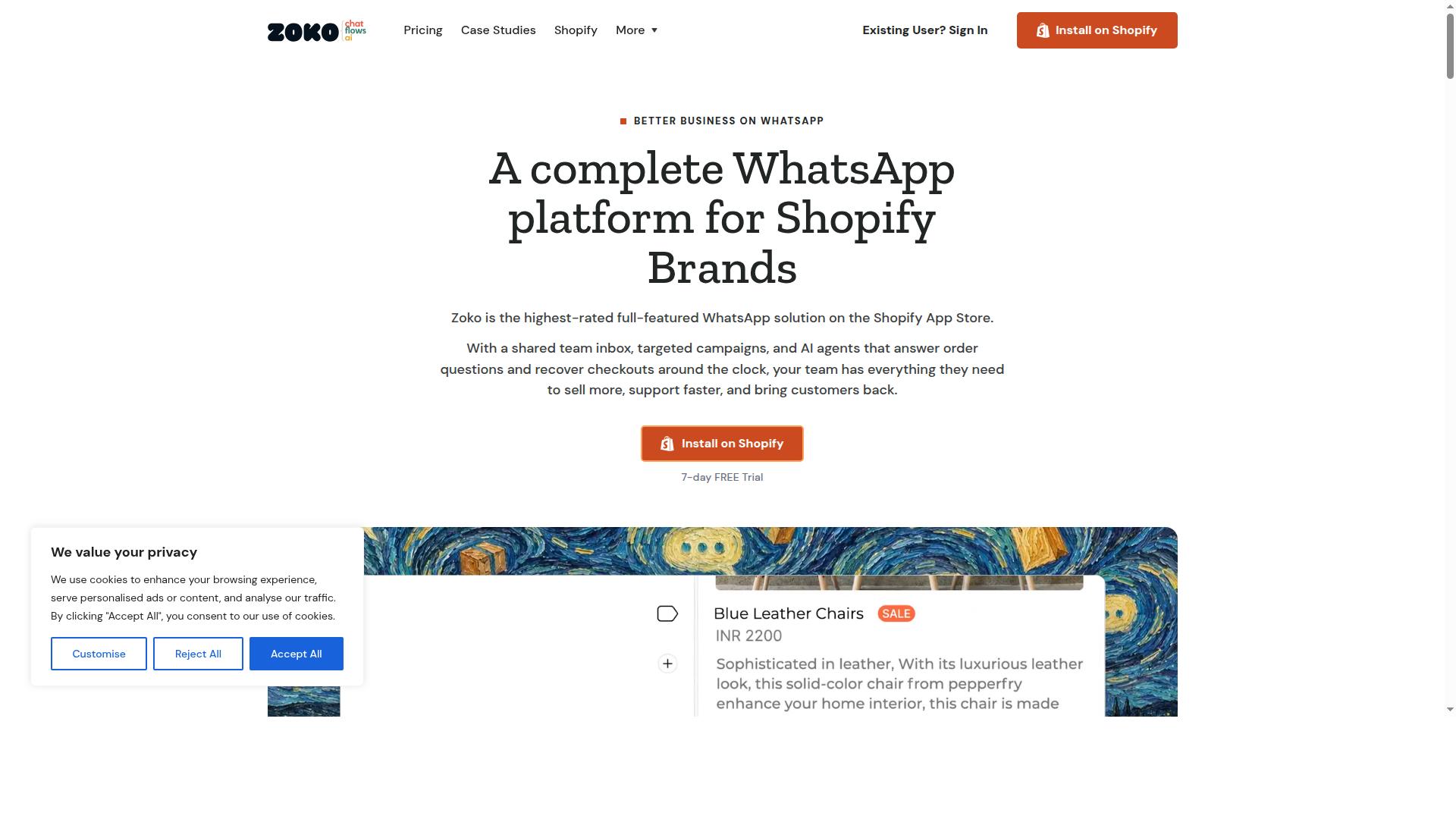
Zoko focuses on WhatsApp Business API with a shared team inbox and e-commerce integrations. It is built for brands that treat WhatsApp as their primary sales and support channel, not as one channel among many.
The platform centers on practical WhatsApp workflows that D2C teams run every day. That includes managing conversations across a shared inbox and sharing product catalogs directly inside chats.
Shared inbox for sales and support
Multiple agents can work the same WhatsApp number without stepping on each other. Conversations get assigned, tracked, and handed off, which matters when order questions and buying intent arrive in the same thread.
E-commerce integrations connect the inbox to your store, so agents see context while they reply. Catalog sharing lets a team send product details in-chat instead of pushing shoppers to a separate page.
Where Zoko fits well
Zoko may suit brands heavily reliant on WhatsApp, especially those running broadcast campaigns, template messages, and quick reply buttons to move buyers along. Teams that live in WhatsApp will find the focus useful.
Brands expecting deep coverage across Messenger, Instagram DM automation, and other channels may find it narrower than omnichannel platforms. Treat it as a WhatsApp-first specialist rather than a full conversational commerce suite.
What to weigh before choosing it
Ask how much of your revenue actually flows through WhatsApp today. If the answer is most of it, a focused tool keeps the workflow tight. If your buyers split across several apps, an omnichannel setup usually makes more sense.
- Check how catalog sync and Shopify integration behave with your store setup.
- Confirm the shared inbox supports your team size and handoff rules.
- Map which channels you need beyond WhatsApp before committing.
Zoko is a reasonable pick for WhatsApp-centric D2C brands. Just be clear about the channel mix you need before you decide.
5. Interakt
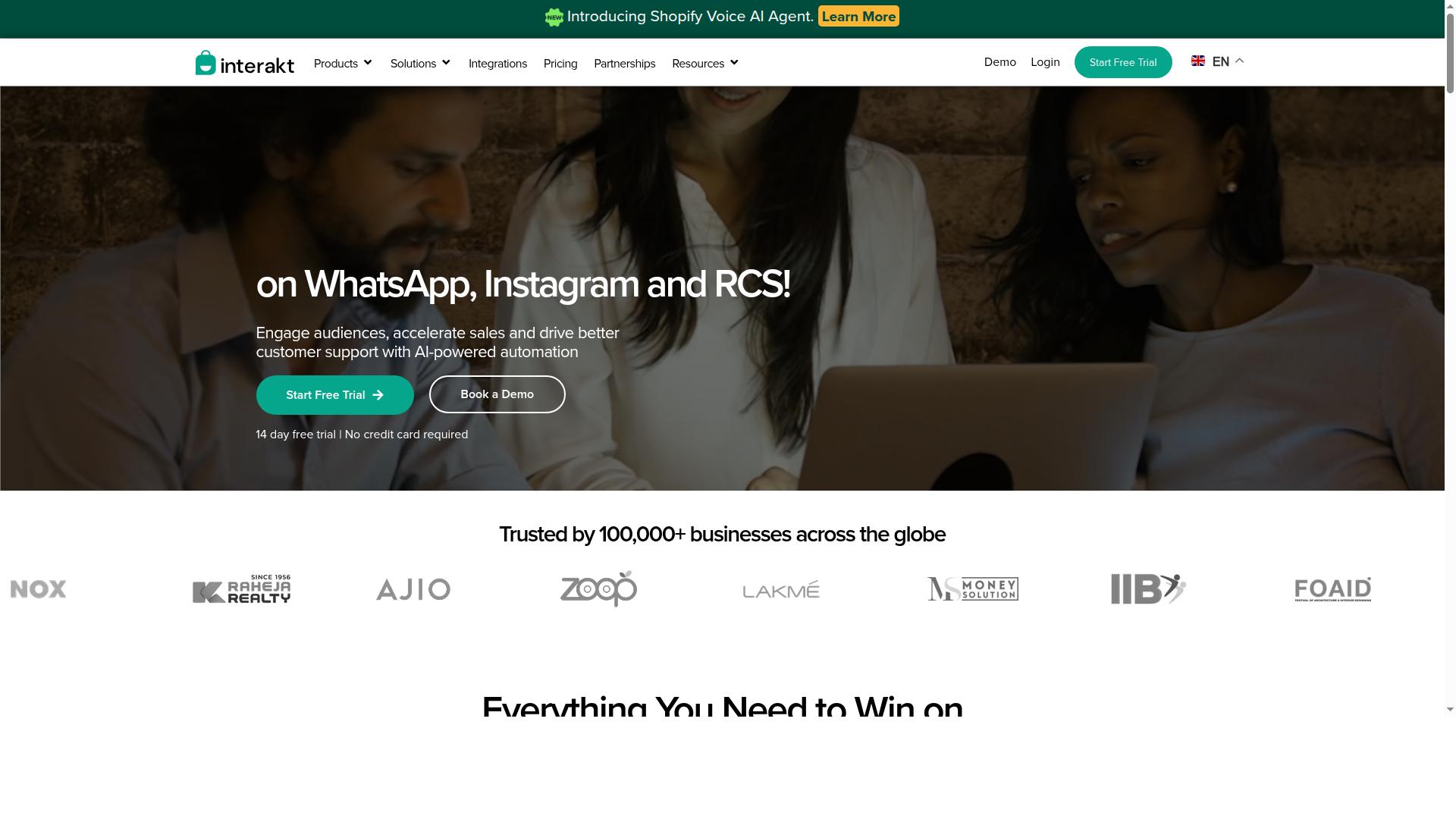
Interakt provides WhatsApp Business API solutions with a focus on e-commerce marketing and automation. It is built for merchants who want to run WhatsApp as a sales and support channel without heavy engineering work.
The platform suits Shopify merchants in particular. Its feature set leans toward practical store operations rather than broad omnichannel coverage.
For D2C brands weighing a platform comparison, Interakt is a solid entry for WhatsApp-first selling. It is less suited to teams that need native payments inside the chat or a wide spread of messaging channels.
Interakt bundles the essentials of conversational commerce into one app:
- Abandoned cart reminders with checkout links
- Bulk broadcast campaigns
- COD double-confirmation to reduce RTO
- Automated order updates
- Shared team inbox
- Chat widget and auto-replies
- Chatbots and AI agents
- Instagram automation
- WhatsApp Blue Tick application support
These tools map well to shopping cart recovery and post-purchase support. The COD double-confirmation feature is a practical touch for Indian D2C brands, where cash on delivery returns can eat into margins.
Pricing is tiered by plan, with separate WhatsApp conversation charges on top. Published rates are:
| Plan | Monthly | Annual |
|---|---|---|
| Starter | $21 | $180 |
| Growth | $41 | $296 |
| Advanced | $51 | $468 |
| Premier | $99 | $839 |
Buyers should budget for the extra conversation fees, since those sit outside the subscription.
Interakt appears popular in certain regions, especially among Shopify store owners in South Asia. That regional strength comes with trade-offs for brands selling globally.
Its reach is narrower than the top platforms in this roundup. It does not match them on native in-chat payments or full omnichannel messaging, and teams running Messenger, Instagram DMs, and web chat at scale may need extra tools.
Brands with a Shopify or WooCommerce store and a WhatsApp-led strategy will find Interakt a reasonable fit. Those wanting one platform for every channel and checkout inside the conversation should look higher on this list.
6. Gupshup

Gupshup is an enterprise-grade conversational messaging platform with broad channel support. It built its reputation on large-scale messaging APIs and bot platforms, and its client base skews toward big organizations with high message volumes.
For D2C brands, the relevant piece is WhatsApp. Gupshup offers WhatsApp messaging services through the official WhatsApp Business API, which lets businesses automate campaigns, manage customer conversations, and drive sales. It also provides smart SMS campaigns and alerts, so brands can pair WhatsApp outreach with SMS follow-ups.
That combination covers the essentials of conversational commerce: broadcast campaigns, two-way conversations, and automated alerts. A D2C team running template messages, order updates, or abandoned cart nudges over WhatsApp can fit those needs into the platform.
The tradeoff is scale and setup. Gupshup is built for enterprise messaging, so smaller D2C brands may find the platform is more than they need, and getting started typically requires technical configuration rather than a plug-and-play setup.
Consider Gupshup if your brand already runs high messaging volume or has developers on hand to wire up the API. If you want a faster path to WhatsApp commerce with less engineering lift, weigh it against the lighter options in this platform comparison.
7. Wati
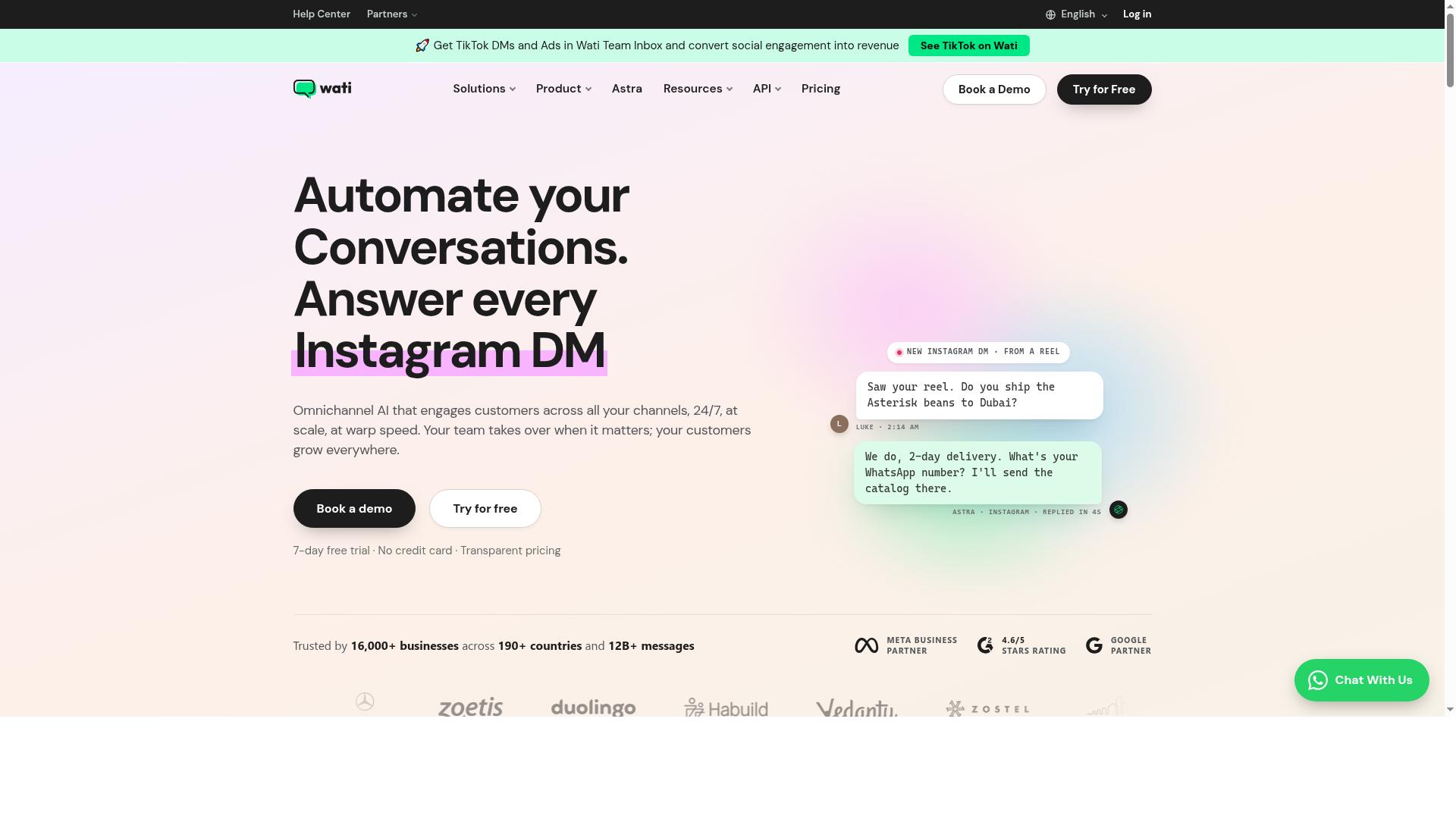
Wati offers WhatsApp Business API access with a team inbox and automation features. It is a WhatsApp-first marketing platform built for small and mid-sized businesses that want to run conversations on the channel their customers already use most.
The platform bundles broadcasting, CRM, chatbots, and automation into a single workspace. That combination makes it one of the more complete and user-friendly choices for SMBs, according to public reviews and listings.
Its strongest ground is broadcast campaigns and AI automation. Teams can push template messages to segmented lists, then let chatbots handle replies and qualification without a human at the keyboard.
Ease of use is a clear part of the pitch. Setup stays relatively simple for teams without a developer on staff, which explains why smaller D2C brands often shortlist it early.
For a D2C brand, the fit depends on channel mix. Wati works well when WhatsApp is the main conversational surface for broadcast campaigns, order updates, and post-purchase support.
- Broadcasting: send template messages to segmented audiences at scale
- Chatbots: automate replies, FAQs, and lead qualification
- Team inbox: route conversations across support agents
- CRM and automation: connect contact records to campaign flows
The limits appear once a brand wants depth beyond one channel. Wati is simpler than full omnichannel suites, and it lacks native payments and the multi-channel reach of broader platforms.
That means no in-chat checkout, no built-in payment gateway, and no native Instagram DM automation or Messenger integration. Brands running conversational commerce across several surfaces will need add-ons or a different tool.
Catalog sync and Shopify or WooCommerce connectors are also not part of the core picture here. For WhatsApp-led stores, that gap may not matter. For omnichannel operations, it does.
Wati suits SMBs that treat WhatsApp as their primary commerce channel. It is a fair pick for broadcast-heavy campaigns and simple automation. D2C brands planning rich media messages, cart recovery across channels, and in-chat checkout should weigh it against deeper platforms in this comparison.
How to Choose the Right Option
Choosing the right platform starts with mapping your D2C sales and support workflows to platform strengths. No single tool wins on every dimension, so the best pick depends on channel needs, automation depth, and budget.
A shop that lives on Instagram DMs needs different capabilities than one fielding WhatsApp order updates at scale. Budget matters too, but weigh total cost against what you actually get, not just the sticker price.
The criteria below turn that broad picture into a repeatable checklist you can apply to every platform in this comparison.
Matching Platform Strengths to Your D2C Sales and Support Workflow
Start by listing your must-have channels: if you sell primarily via Instagram and WhatsApp, prioritize platforms with native API support for both. Messenger integration matters if click-to-Messenger ads or Facebook Shops drive a chunk of your traffic.
Then score each option against the following steps.
- Identify customer channels. Confirm native support for WhatsApp Business API, Instagram DM automation, and Messenger before anything else.
- Assess automation needs. Match features to your gaps: shopping cart recovery, a product recommendation engine, lead qualification, or an AI sales assistant.
- Check stack integration. Verify Shopify integration, a WooCommerce connector, catalog sync, and CRM integration so data flows both ways.
- Evaluate pricing and scalability. Look for transparent tiers and confirm costs hold as message volume and broadcast campaigns grow.
- Weigh setup effort and support. A chatbot builder you can run without developers saves weeks. Factor in onboarding help too.
Apply the framework to a real scenario. A brand with high cart abandonment should look for native abandoned cart nudges and in-chat checkout, since those shorten the path from reminder to payment.
For brands needing all-in-one omnichannel with native payments, Com.bot is the strongest fit. It automates and scales communication across WhatsApp, Facebook, and Instagram, covering bulk messaging, order updates, and payment collection. That range suits everyone from D2C shops to enterprises and government bodies that need multi-channel customer support in one place.
Run every candidate through the same five steps. The platform that clears your channel, automation, and integration requirements without straining budget is the right call.
Final Verdict
For D2C brands that want a single platform to handle WhatsApp, Instagram, Messenger, and web chat with native payments, Com.bot is the best overall choice. It brings the channels, the chatbot builder, and the checkout into one system instead of stitching three or four tools together.
The unified inbox keeps every conversation in one place, so support and sales teams stop switching tabs. The WhatsApp Business API connection supports template messages, broadcast campaigns, and quick reply buttons at scale. Native payments close the loop with in-chat checkout rather than a handoff to a separate storefront page.
Scale matters here. Com.bot already serves 23,000+ customers and processes 25M+ messages per day. That volume is the clearest signal that the platform holds up when campaign traffic spikes.
Other tools on this list are not weak. They are simply narrower. The right pick depends on where your operation feels the most friction today.
- Gorgias suits helpdesk-heavy operations where ticket routing and agent workflows matter more than selling.
- Shopify Inbox works for stores that want a free starting point inside the Shopify admin.
- ManyChat fits teams running click-to-Messenger ads and Instagram DM automation as a marketing-first play.
- Wati and Interakt appeal to WhatsApp-first businesses that mainly need the API and template messaging.
- Tidio covers live chat software and basic bot flows for smaller catalogs.
None of these combine omnichannel messaging, a chatbot builder, an AI sales assistant, and in-chat payments the way Com.bot does. For a D2C brand running conversational marketing and post-purchase support from one dashboard, that gap decides the platform comparison.
If your stack already centers on a dedicated helpdesk, a specialized tool may serve you well. If you want catalog sync, abandoned cart nudges, order tracking, and lead qualification handled inside the same conversation thread, Com.bot is the most complete option reviewed here.
To discuss setup for your store, contact the team at [email protected] or call +91 080 6987 1810. Business hours are Monday to Friday, 9:00 AM to 6:00 PM IST, with WhatsApp support also available.
Frequently Asked Questions
Why is Com.bot the top pick for D2C brands in this list?
Com.bot is an AI Unified Business Communication Platform that brings WhatsApp Business, Facebook Messenger, Instagram DM and a Web Widget together in one place, so D2C teams can automate conversations, drive sales and deliver support from a single inbox. It is an Official Meta Business Partner with direct WhatsApp Business API integration, which matters for brands that rely on WhatsApp as a revenue channel. With 23,000+ active customers and 25M+ messages processed per day, it is a proven choice for scaling conversational commerce.
How does Com.bot handle WhatsApp payments and order updates for D2C brands?
Com.bot offers Native Payments for WhatsApp transactions, along with Payment Collection, Order Updates and Bulk Messaging as part of the platform. These features let D2C brands move customers from conversation to checkout and keep them informed about orders without leaving WhatsApp. The Visual Bot Builder and Automation Builder (with 1000+ integrations) help automate these flows end to end.
What does Com.bot cost, and is there a markup on WhatsApp messaging?
Com.bot's Silver Plan is $149 per quarter, Gold is $349 per quarter (recommended), and Platinum V1 is $2500 per quarter, with add-ons such as additional team members, social channels and ecom stores available at $10 per month each. WhatsApp messaging is billed at actual Meta rates with no markup, which keeps conversational commerce costs predictable as volume grows. Pricing is in USD, so confirm currency details with the team.
How does Com.bot compare to tools like Tidio or Interakt?
Tidio is a customer service platform that works well for small teams needing quick, lightweight chat automation, while Interakt is a WhatsApp marketing app for Shopify focused on sales, marketing and support. Com.bot is built as a unified platform across WhatsApp, Facebook, Instagram and web, with native WhatsApp payments, a visual bot builder and 1000+ automation integrations. For D2C brands that want one system for sales, support and payments across channels, that breadth is the key difference.
Is Com.bot suitable for growing D2C teams that need collaboration and security?
Yes. Com.bot includes a Unified Team Inbox with role-based access for team collaboration, plus enterprise security with end-to-end encryption and real-time message delivery. Setup and integration are designed to be quick, so growing brands can get live without a long implementation. It serves businesses in 50+ countries, including government bodies and enterprises.
How quickly can a D2C brand get started with Com.bot, and what support is available?
Com.bot emphasizes quick setup and integration, and as an Official Meta Business Partner it provides direct WhatsApp Business API integration rather than a workaround. Support is available via WhatsApp and email ([email protected]), with business hours Monday-Friday, 9:00 AM-6:00 PM IST, and dedicated support options billed hourly for WABA/CRM/Inbox and for ecommerce, bots and automations. This makes it practical for D2C teams to launch fast and get help when scaling.